Sunday, 6 February 2011

We continue to learn

It has been brought to my attention that it is very difficult to leave comments on this blogger site, so I am trialling TypePad to see if it offers more flexibility.  Sometimes, you just don't know what you don't know! Never having tried to leave myself a comment I was unaware of this problem - so my thanks to one of my Twitter followers.

So please do continue to follow my blogs on the new blog site and let me know what you think.

It never hurts to make a change!!!

I look forward to welcoming you at my new home.

Ian Perry

Friday, 4 February 2011

The most depressing jobs

My thanks to @SimonHague for tweeting the top 10 most depressing jobs as listed in the New York Daily Times:
  • nursing home & care workers
  • social workers
  • health care workers
  • artists, entertainers, writers
  • teachers
  • administrative staff support
  • maintenance & ground workers
  • financial advisors & accountants
  • salespeople
When I read this I reflected on a previous blog of mine on Patrick Lecioni and how 'people don't leave companies they leave bosses'.  A recent article in People Management looks at the growing threat of 'presenteeism' and how people are turning up for work despite illness, but are not operating at full capacity.  The Sainsbury Centre for Ill Health research states that 'presenteeism' accounts for 1.5 times as much work lost as 'absenteeism', but could cost more as it is more common amongst higher paid staff.  They estimated sickness absence was costing £8.4 billion a year, whilst 'presenteeism' cost £15.1 billion, and that was before the recession!

So, back to Lencioni's comment.  I wonder if there is a different kind of risk associated with 'presenteeism'.  How many staff keep coming to work but don't want to be there?  I wonder what are the costs to the business of these demotivated people and what impact are they having on others around them?  

So, my challenge is this, let's start looking at engaging people, having some challenging conversations about why they are not performing, and maybe we should start being a bit more 'adult' if people don't want to be there.

We might well start with scrutinising ourselves.  Are we providing staff with clarity about the jobs we want them to do, are we equipping them to do the best job possible with the right tools and training and is it interesting to them?  

If that's not the answer then maybe helping them to get out of a job they find miserable might be the best thing that you could do for them.  I am not talking about redundancy, but supporting them to make some choices and motivating them to find the job they really want.

If you need some help, I can offer a range of psychometric and coaching options that could enable you to have these conversations, raise awareness and understanding of what motivates different people at work, increase engagement and ultimately drive effectiveness and profitability. 

Friday, 28 January 2011

Bonuses and why the carrot and stick don't work (in most cases)

Much has been discussed and written about the bank bonuses, the state of the economy and the recently reported growth in manufacturing.  My thoughts have turned to how we maintain momentum in what is still an unsettled economy.


So what will drive the economic engine?  In my opinion, it is PEOPLE. Ultimately, how motivated they are to work and go beyond what is required.  That will make the difference.


I wrote in a previous blog about Daniel Pink's thoughts on motivation and I would recommend his book Drive or watching the animation of one of his lectures on You-Tube.


Pink talks about motivation and that the key is providing 'autonomy', 'mastery' and 'purpose'. These are internal or INTRINSIC motivators which refers to motivation driven by interest or enjoyment in the task itself rather than relying on some external pressure.


The external motivating factors or EXTRINSIC motivators have a 'carrot & stick' approach which, in most cases, do not work.  He identifies 7 flaws of motivating people in this style of "if you do X, then you will get Y":

  • they can extinguish intrinsic motivation
  • they can diminish performance
  • they can crush creativity
  • they can crowd out good behaviour
  • they can encourage cheating, shortcuts and unethical behaviour
  • they can become addictive
  • they can foster short term thinking
So my questions are:
Are you getting the results you want from your staff?
What methods, processes and means are you using to motivate and reward your staff?
What might you achieve with a change in approach?

Monday, 10 January 2011

Achieving your goals in 2011

Happy New Year to you!  I wonder if you have set some New Year's resolutions, personal or professional goals, or just want to make some improvements at work?

Lots of blogs, tweets and articles in the Press have been offering thoughts regarding this annual process.  I imagine for many of you, that you will not achieve what you desire and will likely be disappointed.  In fact, many might have given up already!

I thought I would add to the debate, not by discussing that we should set goals, but more about how to increase the chances of success. 

First, I want to share a story of sporting excellence.  In his book Inspired, Sir Steven Redgrave talks about the fact that "sport isn't always about the most talented.  Talent is god-given raw material, but it's what happens next that counts".  He fondly recounts the tale of John Nabers, a college kid from Illinois, USA who he believes "must go down in sporting history as the finest example of human refusal to be deterred by an apparently insurmountable goal".

John Nabers went to the 1972 Munich Olympics as a 'domestique', the college backstroke champion who would swim the heats of the medley relay allowing Mark Spitz to swim the final and win one of seven gold medals.  Nabers did his job, but made a vow that next time it would be different!

He did his homework, extrapolating and calculating that to achieve individual gold in the 100m backstroke would require a time of 55.5 secs.  At that time his personal best was 59.5 secs, which is a huge gap in swimming terms.  He nearly gave up, but instead looked at the gap in a different way.  He had 4 years of training, so that meant reducing the time by 1 sec a year!  He then broke it down again.... 
  • he trained for 10 months a year, so would need to improve by 1/10th second every month
  • with roughly 30 days in a month, he would need to improve by 1/300ths second every day
  • training for 4 hours a day meant he calculated that he would only need to improve by 1/1200th second every hour - THAT WAS ACHIEVABLE!!
Clearly, it was harder than that for the next four years, he had to develop new strategies, tactics, changes to his technique, diet and training in order to keep on delivering those small improvements.  But he made the Montreal Olympics and with a time of 55.49 sec he was crowned Olympic and World Record holder, winning a further 3 gold medals.

So, how can this approach work for you?

Often, we use SMART objectives, but don't look at trying to break them down further into 'bite-sized chunks' or how we might actually achieve them.  Try using these as a start point:
  • clarify your goals - be really clear on just what it is you are trying to achieve
  • establish a measure of success - how will you know that you have achieved it?  Frame this in terms of a positive outcome.  So rather than "lose weight" think of "I will have more energy to play football with the kids".
  • break the goal down into smaller steps and measures - such as Naber's 1/1200th second every hour.
  • concentrate your mind on how you will actually achieve each small step - what have you got to do differently, better, start or stop doing?
  • regularly review your progress and your actions - find someone whom you respect and trust that can play a variety of roles from support to challenge or, if it works for you, just plain nag!
If you would like some help in clarifying and implementing personal or business change this year, give me a call.  The benefit might well be far higher than the cost!


Monday, 29 November 2010

Resilience!

An article in November Coaching at Work magazine considered the current and future trends for coaching and commented that people are experiencing more pressure in the workplace as a result of cost cutting and restructuring, which was particularly so in the public sector.  The resulting pressure can either push people to produce amazingly high performance or it can push them to the edge, destroying performance.

I was also struck by a blog by Nick Robinson of the BBC, who said that "we all thought the Spending Review was the toughest set of decisions ever to face a modern Prime Minister.  Perhaps.  But it also blocked out the day-to-day realities of power when things beyond your control and over which you do not take decisions go wrong.. and then go wrong again.. and then again..."

Both of these made me think of a theme that I have noticed being talked about increasingly by communities on Linkedin and Twitter of Mental Toughness and Resilience.  Resilience is a characteristic I am very familiar with being an accredited practitioner of Emotional Intelligence.

The 'Resilience Factor' by Karen Reivich and Andrew Shatte talks about resilience:
everyone needs resilience, because one thing is certain, life includes adversities.  There are inevitable daily hassles - work dumped on your desk at 4.45pm, children who need to be in the same place at the same time, disagreements with others.  There are probably major setbacks too - a lost job, a failed relationship, and recent events have shown that our lives may also be touched by great trauma.  But if you increase your resilience you can overcome most of what life puts your way.

How resilient are you? Most of us would consider ourselves to be fairly resilient, but most of us are not emotionally or psychologically prepared to handle adversity, which means that instead of facing up to our problems bravely and with confidence, we risk giving up and feeling helpless.

So in the language of emotional intelligence we talk about 'Self Management', which can be described as the emotional competency to manage our energy and emotions in a restraining or energising way:
  • Restraining behaviours:
    • keeping disruptive emotions and impulses in check
    • maintaining integrity and acting congruently with our values
    • flexibility in handling change
  • Energising behaviours:
    • striving to improve or meet a standard of excellence
    • readiness to act on opportunities
    • resilience in coping with setbacks and pursuing goals despite obstacles and setbacks.
So in these current times, I wonder if we might all benefit from exploring our ability to deal with adversity, set backs, and be more prepared and able to keep picking ourselves  and others up despite set backs and the difficulties of handling change.

If you would like to comment or would like to know more about Emotional Intelligence then do please get in touch!

Monday, 22 November 2010

People don't leave companies they leave bosses!


That was the profound statement made at a conference I attended this week in London and one that has stuck in my mind all week.

The statement was made by Patrick Lencioni, author of best-selling books including 'The Five Dysfunctions of a Team'.  There have been numerous studies in the UK that highlight the dissatisfaction that people feel with their bosses and in my coaching sessions it is often something we will focus on.  People are quick to identify with bad bosses rather than good ones!

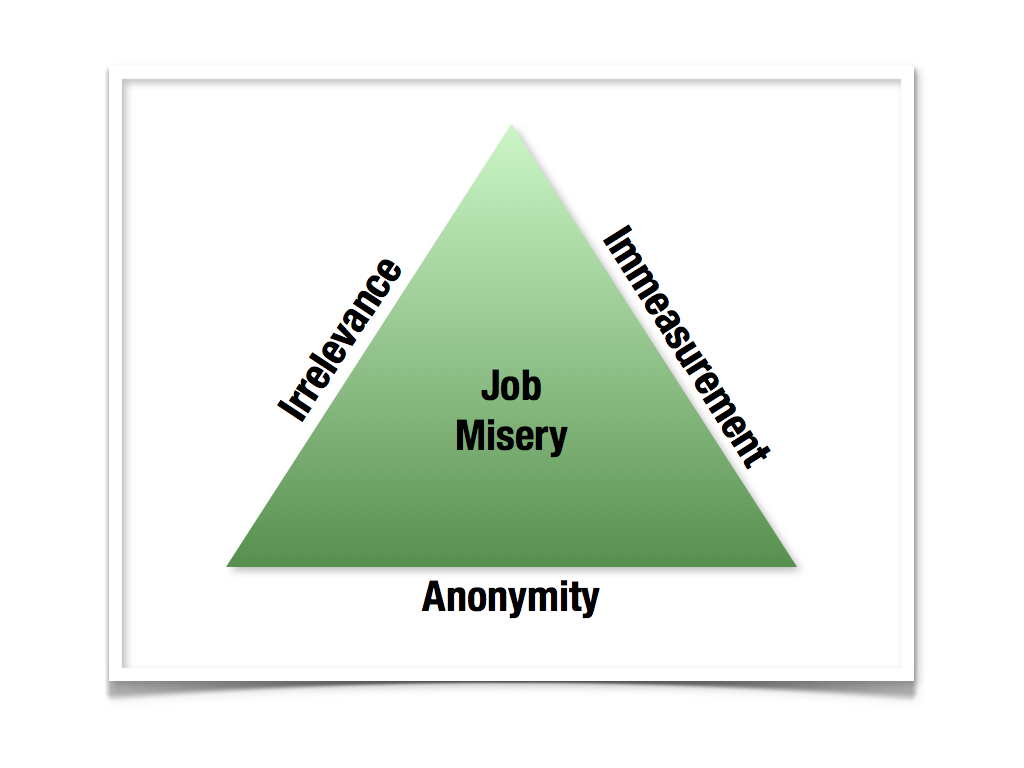
At the conference Lencioni offered a great model to overcome people leaving through job misery, which is further explained in his book 'The Three Signs of a Miserable Job'.  He describes the three components as:


Anonymity: employees who are not known and individually appreciated by their managers will not be fulfilled in their jobs.
Irrelevance: employees who don't know how their work impacts the lives of others will not be fulfilled in their jobs.
Immeasurement: employees who cannot assess their own level of performance and success will not be fulfilled in their jobs.

So, I put this to you, are you doing your best to ensure that your teams and direct reports don't have 'miserable jobs'?  In a recent discussion with a client, they said how they feared an exodus of talent from their organisation when the economy picks up.  Make sure that doesn't happen to you! 

Sunday, 14 November 2010

Should CEOs have a coach to help them reach peak performance?

This was the title of a recent discussion on Linkedin which was fascinating in the reactions and conclusions provoked.


The discussion was part of an Institute of Directors (IoD) group on Linkedin and the contributors included company CEOs, Directors as well as a range of Coaches, Mentors and Consultants.


What emerged from the discussion was:

  • some cynicism regarding the need for coaching and advice for CEOs.
  • a passionate defence from Coaches, Mentors and Consultants for their profession and clear 'sparring' about the differences between the methods used.
  • some 'sniffyness' (on reflection, me included) about the coaching profession and people too easily entering the profession and calling themselves Coaches.
  • challenge back to the CEOs that they were dismissing the need for continual learning.
  • a clear confusion about what coaching is and how to make the right choices when selecting of a Coach.
As the discussion came to a natural end, there appeared to be a convergence.  Some of those who started out as cynics ended up with a greater understanding of what coaching and mentoring might offer them.  We as a coaching profession realised that we need to do a better job of helping people to buy our services.

So here are my thoughts on buying coaching:
  • ask what training they have undergone and where.  Ensure it is of a good quality and from a reputable provider.
  • ask which professional bodies they are a member of and what code of ethics they subscribe to.  The lead organisations are Association for Coaching (AC), European Mentoring and Coaching Council (EMCC), International Coach Federation (ICF)
  • if they use psychometric testing, are they 'Level B' accredited by the British Psychological Society to use them and which ones are valid for your needs.
  • what Supervision do they receive?  All good coaches should have a Supervisor who helps them to reflect on their approach and improve their practise.
  • how they propose to 'contract' with you - in other words, what are the 'rules of engagement'.
  • what are they doing for their own professional development?How many days a year are they investing in their own training and development?
  • insist you have a 'chemistry' session and decide whether you think you can work with them!
I would be interested in your thoughts and experiences on buying coaching services.

Friday, 29 October 2010

Working on our strengths?

Marcus Buckingham is credited with saying "we spend less than 15% of our time working on things that relate to our strengths".

Talent and personal development discussions are often centred around fixing 'weaknesses'.  Managers feel they quickly discuss achievements then spend the most part of the time identifying and working on 'areas for improvement'.  I wonder how this impacts on experiences of performance management for those doing it and equally those having it 'done to them'.

Certainly the challenge in current times is for organisations of all sizes to drive performance and increase turnover & profitability.  I wonder what impact we could have if we allowed people to play to their strengths, with the focus on how these are leveraged.

As a coach, I frequently have conversations around motivation and job satisfaction.  I notice the difference in my clients energy when I am helping them to understand the areas where they are at their best, compared to that when working on their 'weaknesses'.

Using a swimming analogy, how might we appraise Rebecca Adlington if we lost sight of her prowess at 400 & 800m freestyle? Would we be telling her to really focus on improving her butterfly stroke?

So, do you know your strengths and do you give yourself the opportunity to use them.  If you manage others, have you helped them to understand and apply theirs?

I would love to hear what you achieve!


Friday, 22 October 2010

What drives you?

I was recently introduced via Twitter to Daniel Pink, a thought leader and author of 'Drive'.  He encourages us to forget everything we thought we knew about motivating people, he says the secret to high performance and satisfaction is the deep human need to direct our own lives, learn to create new things and do better by ourselves and our world.

He describes the three elements of true motivation as:
  • Autonomy - the desire to direct our lives
  • Mastery - the urge to get better and better at something that matters
  • Purpose - the yearning to do what we do in the service of something larger than ourselves.
His book challenges the long-held philosophy of 'carrot & stick' and explores why this approach often does not work.  Pink recognises that people need to earn a living, but once past a personal threshold, the 'carrot & stick' can produce precisely the opposite of its intention.  He says that they can "transform an interesting task into drudge; turn play into work; send performance, creativity & even upstanding behaviour toppling like dominoes".

Personally, 'carrot & stick' has never done it for me, in fact, autonomy and mastery resonate very strongly.

Which ones resonate with you?  Let me know!

Monday, 13 September 2010

Coaching: is it for me?

It has been proven that leadership and management skills have a direct impact on the performance of a business.  Improving your personal impact and performance can help you to achieve a wide variety of goals, such as:
  • taking up a leadership position
  • seeking a new career
  • getting more done
  • becoming more strategic rather than operational
  • changing others' perception of you
  • building relationships with key people
  • transitioning from one role to another
  • increasing employee motivation
But how can these improvements be made within a busy working week?  Coaching is particularly good as it can be used in 'bite-sized chunks' allowing you time and space to take stock and develop your own sustainable solutions.


So what is coaching?

Here are a few definitions that you might have seen before:

"Give a man a fish and you will feed him for a day,
Teach a man to fish and you will feed him for life, 
Teach a man to learn to fish and he doesn't need a fishing teacher,
Teach a man to learn and he doesn't need a teacher."  (Chinese proverb)

"Unlocking a person's potential to maximise his or her performance.  It is helping a person to learn, rather than teaching him or her"  (John Whitmore)

My view of coaching is that you have the resources to solve your problems.  My role is to develop your resourcefulness through skilful questioning, challenge and support.  I will help you to understand how your personality and your experiences impact on your performance.  I suspend judgement and we work together as equals to bring about change and action that you feel comfortable with, that produces sustainable improvements.  It's not about giving advice and telling you what to do, it is about helping you to find the right solution.


How does it work?

Normally coaching takes place over a 3-6 month period and involves 4-6 sessions of around two hours each.  It involves exploring your issues and dilemmas to find which actions you want to take.  At each meeting we review progress and move to new issues as required.  I am often asked by clients to complete some kind of personality and motivation reports as part of the coaching.  These can be extremely useful in raising a higher level of self-awareness.


Is it for me?

Coaching is useful from front line staff to senior managers, public to private sector, sports to business.  Why not give it a go to see if it can help you to get a solution to your current issues.  

So, if you think you might be interested, please do contact me and we can talk and meet to see if it's for you.

(If you are based in the West Midlands, you might qualify for funding under the Director Development Programme (DDP) run by West Midlands Business Link with whom I am an accredited supplier)

Friday, 3 September 2010

10,000 hours to expert mountain biker!

In my blog last week I reflected on my day mountain biking and recognising that if I wanted to stop falling off when going up hill, I needed to improve my knowledge and skill.

So what have I done about it?

I have gone through my collection of articles in mountain biking magazines, checked out a couple of books and looked on the internet.

I have also been out on my bike again and tried to practice the turns even though the terrain at home is not so extreme.  I also realised that I can join up with some riders from my local bike shop and watch how they do it and maybe get some instruction too.  I just need to make that call!

This is what I do in my professional life.  As a coach, I am always looking to develop my own knowledge and skills.  I read many books, articles, browse the web, Linkedin and Twitter.  I also talk to other coaches, both within my field and outside, such as sports coaches and life coaches.  I also undertake professional supervision, which is really someone coaching me to reflect on how I coach and how well I am doing it.

So in your professional life what are you doing to improve your skills and knowledge?

If you manage or interact with others are you reflecting on your style or seeking feedback?
Are you investing in training?
Do you observe others who you consider to be expert in their field and learn from what they do?
Do you read around your specialism?
Do you try new things out and see how they go?

I would love to hear your experiences.

Friday, 27 August 2010

The 'trail' to expert mountain biker

It's Sunday and I have just got back from spending a day trying out a new mountain bike trail at Cannock Chase.  I have done the route a number of times, but it has recently been extended and given a great rating by MBR magazine.  I am relatively new to mountain biking and can call myself a MAMIL - a middle aged man in lycra!

I ride mainly in the Cotswolds where I live, but I love the technical challenge and exhilaration, of a trail centre single-track, going fast through the trees, over drops and round the berms!  Great fun, but a little scary too, if I am honest.

So I sit here now, aching a little after 15 miles of concentrating hard on the single-track, reflecting on how I rode today.  I started nervously; heavy rain had made it muddy, my back wheel would not grip and my technique was really rusty.  I hit a couple of trees and had to put my feet down a couple of times as I misjudged corners and hazards.  I only had myself to blame, as I hadn't warmed up, I had got straight out of the car and hit the trail!

My technique and riding did improve, as I warmed up and my fitness kept me going.  But I  kept falling off going UP HILL round tight bends!  I seemed to be doing it quite regularly.  I realise that this is because I don't actually know how to do them and when I do get round I am sure I don't look as 'pretty' as the professionals.

So the answer, I need to PRACTICE!

A couple of weeks ago in my blog I said that it was not talent but practice that made you an expert.  Well, I need to practice, but it needs to be 'deliberate and purposeful' practice.  So I need some lessons, observe an expert and really read the tips in the many magazines that I have scattered around the house.  Then get out there and keep practicing!

If you want to be the best that you can be, you have to put the hours in (remember that magic 10,000 hours?)  Consider some lessons, some coaching, or just some time thinking about what you have done and reading deeper into the subject to enhance understanding.

I would really like to hear about what skills you are practicing at the moment.  


Thursday, 19 August 2010

How understanding your personality preferences helps drive Innovation

Today, more than ever, businesses need innovation. They will not survive simply by relying on the same processes, same thinking, same planning as before.
Innovation can be described as the “implementation of ideas” and starts with defining the problem, discovering alternatives, deciding on and implementing a solution.
So how can personality help or hinder this process?
We know that that there are no right or wrong personalities but all of us have preferences that influence the way we interact, think, make decisions and plan. 
So when we manage and lead innovation, our preferences can influence how we approach the process and where we focus our attention.
So when you look at the fours descriptions in the table, which one best describes how you work when when you are dealing with innovation?
Understanding which profile best describes you can help you to understand why you find some parts of innovation easy and others hard work. It can also help you to identify others in your business who might enjoy other parts of the innovation process.
When you are managing innovation, how do your preferences differ from others and are you providing the right stimulus for others to be as innovative as possible and play to their strengths or could you be stifling them through your actions and preferences?
If you would like to know more about how you can use an awareness of personality to help drive innovation please do call me 

Friday, 13 August 2010

What's the secret of high achievement? It's not talent or natural genius. The key is PRACTICE!

Talent is a subject that I frequently reflect on and encounter in my daily work as a coach and as a father of a 'talented' swimmer.

I have read with interest over the past six months, two books on Talent - 'Outliers' by Malcolm Gladwell and 'Bounce' by Matthew Syed.  The September issue of Wired magazine reviewed these books, along with two others, and concluded:
  • the difference between expert and normal performance is due to "life-long periods of deliberate effort to improve performance in a specific area",
  • in sport it takes 10 years of deliberate practice,
  • it takes 10,000 hours of practice to be an expert,
  • the month of your birth plays a big part,
  • there is an element of luck!
So what can we make from these insights?  That natural talent is not enough, to succeed you do need to practice and it takes time - a lot of time!

For my son in swimming it is not just about turning up and swimming once a week and doing the lengths.  He attends all his practice sessions over the week, where he is given 'sets' to swim, each of which has a specific outcome in mind.  The swimmers are watched closely by trained coaches and given immediate feedback to make small changes that make all the difference.  The children also record their PB times so that they can measure their progress against set goals that will get them to county, regional or even national times!!

As a coach I seek regular feedback from my clients and I reflect on each session.  In line with best practice in this industry, I regularly have sessions with a trained professional Supervisor.  We discuss how I have been coaching, how this has helped or hindered my clients which raises my awareness of my coaching style, reinforces what I do well and identifies further development areas to address.

So in our specialist fields, if we truly aspire to be best in class or considered an expert, how many hours of deliberate practice are we doing?  Or are we just turning up and doing what we have always done?  To what extent are we reflecting on the daily situations and challenges that we face, and how often do we seek feedback on our performance.

What are you doing to help improve your natural talent?  I look forward to hearing your stories.

Friday, 6 August 2010

So, where did you go?

A month ago I talked about how your choice of holiday might reflect your MBTI preference type.

So, if you chose a holiday that was busy, where you met lots of new interesting people, it might indicate an EXTRAVERSION preference.  This means you prefer to draw energy from the world around you and from contact with people.  These types learn best through doing or discussing and tend to speak and act first then reflect later.  So at work you might feel comfortable taking on a visible role, be prepared to alter a decision to meet external demands and delegate liberally. 

If you chose to spend the holiday with a few close friends having a lovely 'chilled' time then you may have an INTROVERSION preference.  This means you prefer to draw energy from your internal world, through quiet reflection.  These types learn best by reflection and mental practice and tend to reflect before acting or speaking.  At work you might feel more comfortable working behind the scenes, feel reluctant to alter a decision to meet external demands and you may delegate sparingly.

Do you recognise yourself in any of these or maybe a colleague who is the opposite of you?  Or are you a combination of both?

If you would like to find out more about how MBTI can really help you in the workplace then please do call for a chat.


Wednesday, 28 July 2010

Have you packed yet?

Following on the MBTI theme, the fourth dimension looks at how we take action.

  • Was your packing planned weeks ago, with lots of lists and putting things in the spare room 'ready'?
        OR
  • Will you leave it to the last minute and maybe even buy at the airport, saying "I'll see what's there"?
Those with a JUDGING preference like to live life in scheduled and orderly ways.  They like to make plans and stick to them, taking great satisfaction in getting things done.

A PERCEIVING preference likes to keep open to new experiences and information.  Living life in a flexible, spontaneous way, going with the flow and taking advantage of last minute options as they arise.  They feel constrained by plans and structures.

Problems in the workplace may occur when completing a project.  Perceiving types often start tasks at the last minute whilst Judging types are focused on the deadline and plan their work, they find it difficult to trust that the Perceiving types will finish in time.

How do you like to organise a project?  What conflicts have you encountered on the way?

I would love to hear from you.

Thursday, 22 July 2010

How might you resolve family conflict on holiday?

Following on the MBTI theme, the third dimension looks at how we make decisions.

When there is a disagreement about what you are going to do on holiday, how you resolve it may indicate which MBTI preference you have.


  • Do you settle it by making sure everyone gets their 'fair' share?
        OR
  • Do you assess the impact of decisions on each person?
Those with a THINKING preference make decisions from a detached standpoint.  They analyse the logical consequences of a choice or action and use consistent rules and principles.

A FEELING preference would mean that decisions are made from an involved standpoint, by gauging the impact of actions.  They prefer to make decisions that take account of individual needs.

These both describe decision-making processes, it doesn't mean that Thinking types don't have feelings or that Feeling types are incapable of logic, it is just that they use different criteria to make their decisions.

Feeling types strive for harmony and positive interactions and may appear to be a bit 'soft and tender' by Thinking types.  Thinking types want to solve problems with logic and want everyone to be treated equally.  Feeling types might interpret them as being 'tough minded' and possibly abrupt and critical.

How are you making your decisions today?  How do others around you make decisions?  Does that sometimes leave you feeling confused?

Let me know!

Friday, 16 July 2010

What postcard do you send home?

Following on our Holiday MBTI theme....

....When you send a postcard home will it be

  • a montage of all the places you have visited, so that those back home can really get an idea of where you are?
        OR
  • a sunset - it represents so many things!
How you answered can indicate whether you have a preference towards SENSING or INTUITION.  These relate to the types of information you prefer to pay attention to:

SENSING types prefer specific information and facts to find out what is happening.  They are observant of what is going on around them and especially focused on the practical realities of a situation.

INTUITION types prefer to attend to the associations between facts rather than the facts themselves.  They are interested in connections and looking for ideas and possibilities.

In the workplace there is the potential for confusion in communication when the preferences aren't recognised or understood.  Sensing types might be sceptical of concepts and want to see concrete evidence that the idea will work.  The Intuition types interpret lots of questions as being nit-picky or challenging.  If they can't give the facts and details, the Sensing types see the idea as impractical.  On the other hand, Intuition types become bored with the lengthy details and facts presented by the Sensing types!

Next time you are trying to 'sell' and idea just consider what the other person's preference might be.

Let me know how it goes!

Friday, 9 July 2010

What's your ideal summer holiday?

What does your choice of holiday say about your MBTI preference type?  Would you prefer a holiday that was:
  • busy, with lots of action, full of activities and bursting with opportunities to meet new people?
OR
  • a quiet time to reflect, read a couple of books, spent with a small group of really good friends?

    How you answered can indicate whether you have a preference towards EXTRAVERSION or INTROVERSION.  

    So what's the relevance to the workplace?  Have you ever wondered why you might have such a different approach from others? 

    The Myers Briggs Type Indicator (MBTI) is the most widely used instrument for understanding personality differences.  I use it successfully in coaching individuals and teams in:
    • increasing self-awareness
    • understanding and resolving conflict
    • building team cohesion
    • career development
    Over the coming weeks, on the run up to the holiday season, I will be sharing some more questions for you to ponder on. 

    If this has stimulated your curiosity, please do give me a call to discuss how MBTI could enhance your personal impact and relationship with others.

    Tuesday, 6 July 2010

    "What Leaders really do"

    Following on from my last blog about the need for real consultation and engagement in the public sector cuts, I was interested to see in the July edition of People Management an article focussing on the need for a "boost in capability" in public sector leadership. 

    The CIPD chief economist, John Philpott, comments that the politicians may not have fully considered the "enormous management challenges" that measures to reduce the budget deficit will create in a workforce that will be increasingly demoralised.  He warns that the public sector is "numerically overmanaged" and "qualitatively undermanaged".  The editorial points out that whilst there are some capable leaders, there are not sufficient to deal with the degree of transformation required.

    Whilst I reflected on this, John Kotter's classic Harvard Business Review article "what leaders really do" sprang to mind, in which he says that "they don't make plans;they don't solve problems; they don't even organise people.  What leaders really do is prepare organisations for change and help them to cope as they struggle through it".

    So, how to lead this change?

    There are many leadership models, and one of my particular favourites is Daniel Goleman's Six Leadership styles, as it is so well researched.  His model identifies successful leaders as those who "use one or more of 6 distinct leadership approaches and skilfully switch dependent on the situation".  So here they are:
    • Visionary: they inspire and explain how efforts contribute to the 'dream'.  Through empathy and clarity they move people towards the shared goal.
    • Affiliative: creates harmony that boosts morale and solves conflict.  A useful style for healing rifts or motivating during stressful times.
    • Participative: a superb listener, a team worker, collaborator, influencer.  By valuing people's input they get commitment through participation.
    • Coaching: by listening and helping people identify their own strengths and weaknesses, they encourage, delegate and improve performance by building long-term capabilities.
    • Pacesetting: a strong drive to achieve, high personal standards and initiative, pacesetters get results from a competent team.  But too much and employees feel stifled and have less room to grow.
    • Directive: this style demands compliance, and is more effective in a crisis situation.  It is least effective when used with capable and self-motivated employees.
    So having read the leadership styles, which ones would you say you use effectively, under-use and maybe over-use?

    Hopefully this has given you a little 'food for thought' in managing through tricky times!  I would love to hear from you, on how you are implementing changes.